

The 2026 Sugar Tax Survival Test: As “Low Sugar” Becomes the Price of Entry in Southeast Asia, How Can Brands Compete on Taste?
If five years ago sugar reduction was largely a health trend confined to Western markets, by 2026 it has evolved in Southeast Asia into a regulatory survival test—one that determines whether a brand can be listed, advertise its products, or even maintain its margins.With the MOH Malaysia prioritizing the suppression of Non-Communicable Diseases (NCDs) in the 2026 budget, the domestic food industry is grappling with unprecedented ‘formulation anxiety.
As the World Health Organization continues to urge governments to reduce the intake of “free sugars,” while supporting the use of taxation and grading systems to drive food reformulation, global health anxiety is escalating.
The focus is no longer simply on calorie counts, but on more advanced narratives around glucose spikes and glycation stress.
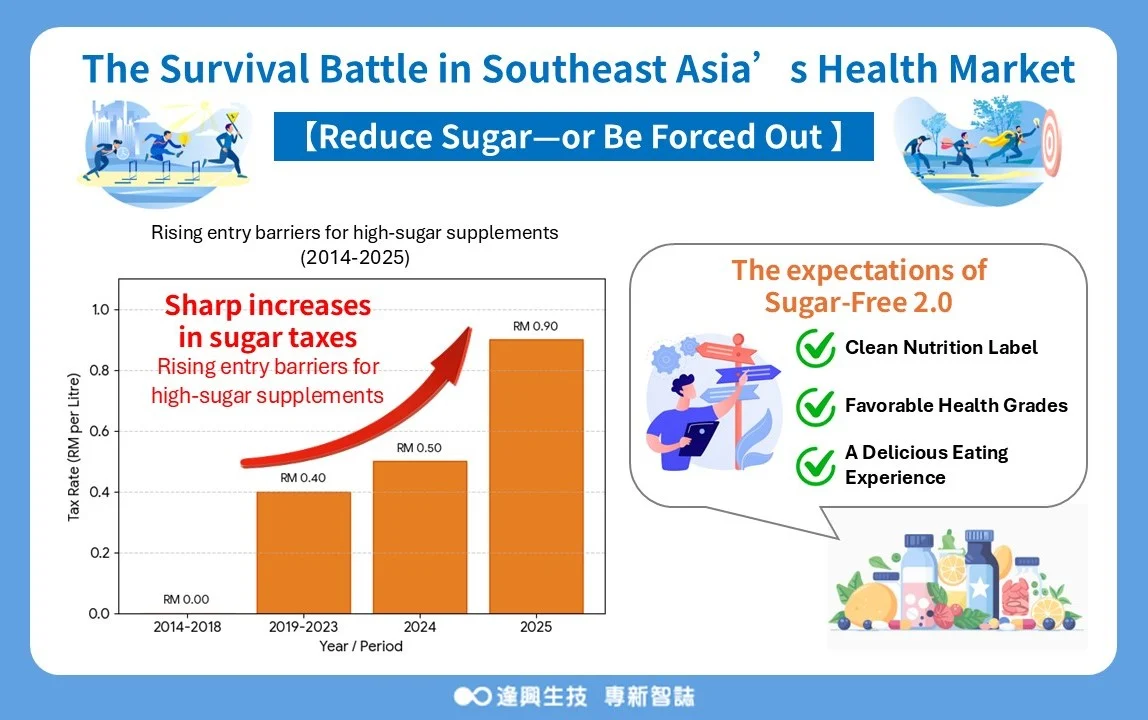
In what can be described as the “Sugar-Free 2.0” era, consumer expectations are increasingly demanding:
they want cleaner nutrition labels and better health grades—without sacrificing taste.
When this trend collides with Southeast Asia’s long-standing challenges around diabetes and metabolic syndrome, an unprecedented regulatory storm begins to take shape.
Southeast Asia’s Sweetness Paradox: Adapt or Be Regulated Out
Southeast Asia has long been regarded as Asia’s “sweetness market,” with high penetration of sugary beverages and functional drinks. Precisely because of this, governments across the region have increasingly turned to sugar taxes and nutrition grading as their most direct intervention tools.
Malaysia
The sugar-sweetened beverage tax has been raised to RM 0.50 per liter, becoming a key policy instrument in the government’s sugar-reduction campaign. As tax thresholds broaden to include categories like powder sachets, sugar reduction has shifted from a health trend to a non-negotiable requirement for profitability and retail viability.
Thailand
Thailand applies a tiered sugar tax system based on sugar content—typically calculated per 100 ml. Products below the threshold are tax-exempt, while higher sugar tiers face progressively increasing taxes.
Rather than outright bans, this structure uses economic pressure to force reformulation.
Singapore
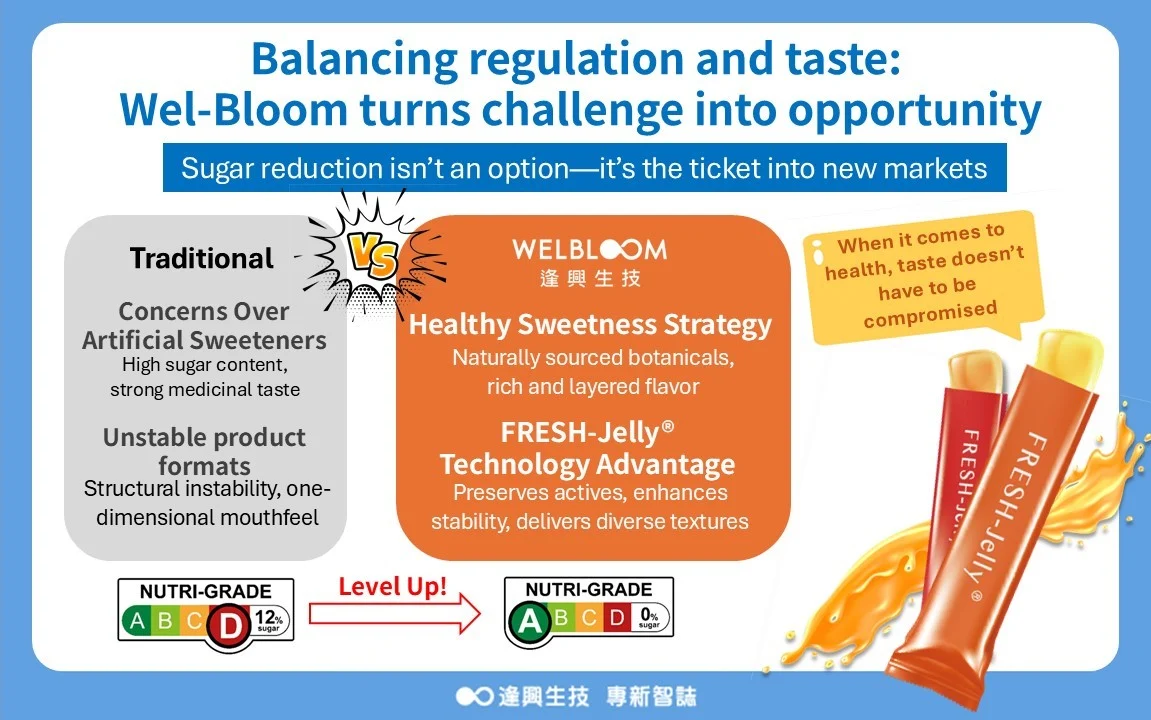
Singapore’s Nutri-Grade beverage labeling system has effectively become a marketing make-or-break line.
Products rated Grade D face strict advertising restrictions—aside from limited in-store exceptions—effectively stripping brands of their ability to communicate with consumers.
For brands, this leads to a harsh reality:
traditional high-sugar supplements—such as collagen drinks, enzyme liquids, and functional gummies—are rapidly losing their regulatory viability.
Fail to reduce sugar, and profits are eroded by taxes while marketing channels are blocked.
Remove sugar without strategy, and an entirely new set of problems emerges.
Industry Reality:What Tastes Good Is Too Sweet, What’s Sugar-Free Tastes Too Bad
Most contract manufacturing supply chains still rely heavily on artificial sweeteners as a one-size-fits-all solution. In liquid and semi-liquid formulations, sucrose does far more than provide sweetness—it is responsible for:
- Masking the bitterness of B vitamins
- Suppressing the fishy notes of collagen
- Building mouthfeel and finish
Once sugar is removed, consumers are often left with:
- A medicinal, syrup-like sensation
- The metallic aftertaste or cooling effect typical of artificial sweeteners
The challenge is even more severe for functional gummies and jellies.
In these formats, sugar is not just a flavor component—it is structural.
Once sugar is reduced in traditional formulations, common issues include:
- Syneresis
- Juice leakage upon opening
- Collapsed texture, hollowness, and loss of elasticity
In Southeast Asia’s hot and humid logistics environment, these flaws are amplified—often translating directly into product returns and negative reviews.
Wel-Bloom’s Approach: Designing for Regulation and Taste at the Same Time
In response to this structural shift, Wel-Bloom has chosen not incremental fixes, but a coordinated redesign across three dimensions: delivery format, sweetening systems, and texture engineering.
1️⃣ Format as Strategy: The Regulatory Adaptability of FRESH-Jelly®
Rather than competing in the crowded, high-sugar liquid beverage space—where taxes and grading systems apply maximum pressure—Wel-Bloom shifts the battlefield altogether.
In most Southeast Asian markets, Wel-Bloom’s FRESH-Jelly® functional jelly is not classified as a ready-to-drink sugar-sweetened beverage, allowing it to sidestep sugar tax frameworks designed specifically for liquids.
At the same time, the jelly format offers small serving sizes and precise formulation control, making it easier for brands to keep total sugar within safe thresholds—qualifying for Nutri-Grade A or B ratings and preserving full marketing and advertising flexibility.
2️⃣ Moving Beyond Artificial Sweeteners: A Flexible Strategy for Healthier Sweetness
In line with global clean-label trends, Wel-Bloom has built a “Healthy Sweetness Strategy Library” designed to meet international regulatory standards. Based on each client’s target market and cost structure, the company flexibly deploys a range of alternative ingredients:
- Erythritol: Serving as a “mouthfeel foundation,” erythritol builds body and volume, helping prevent the hollow texture commonly associated with sugar-free products.
- Monk Fruit Extract: Used as a “premium modifier,” it delivers a smooth, refined sweetness and is a preferred choice for high-end clean-label formulations.
- Steviol Glycosides: A source of “sweetness efficiency,” providing high-intensity natural sweetness. With strong regulatory insight, Wel-Bloom ensures compliance across markets while maintaining clean flavor profiles.
Wel-Bloom’s value lies in customized deployment—whether the goal is ultra-low calories for performance-driven products or flavor profiles tailored to specific regional preferences, the company designs sugar-reduction solutions that fit.
3️⃣ Texture Engineering: Premium Elasticity—Even Without Sugar
The real barrier is not sweetness, but physical structure.
Designed specifically for low- and no-sugar formulations, FRESH-Jelly® is able to deliver the following without relying on sucrose:
- Stable moisture retention
- Syneresis control
- Sustained elasticity and chew
Even under high-temperature logistics and extended shelf-life conditions, texture consistency is maintained.
Conclusion: After 2026, Sugar Reduction Is No Longer Optional—It’s the Ticket In
In Southeast Asia’s 2026 market landscape, high-sugar supplements are no longer just a branding issue—they represent a regulatory risk. Brands now face two paths:
cling to legacy formulations and be gradually edged out by taxes, grading systems, and advertising restrictions;
or upgrade delivery formats, formulations, and sensory performance to regain market eligibility.
As Taiwan’s Leader of jelly supplement, backed by both NSF-GMP and comprehensive HALAL supply chain certifications, Wel-Bloom empowers brands to navigate regional regulations with precision. We offer brands a comprehensive solution that addresses regulation, distribution, and consumer expectations simultaneously.
On the path to sugar reduction, Wel-Bloom holds one belief firm: health should never have to compromise on taste.
As Seen in the Media
The Malay Mail|https://www.malaymail.com/news/
MY Sinchew|https://www.sinchew.com.my/news/20260226/mysinchew/
The Sun Daily|https://thesun.my/business/corporate-news/
Channel NewsAsia|https://www.channelnewsasia.com/
ET Net|https://www.etnet.com.hk/www/tc/news/
Manila Times|https://www.manilatimes.net/2026/02/26/
Contact us right away to start creating products
更多文章


Wel-Bloom Bio-Tech
Leader of Jelly Supplement
-
Phone +886-2-33225555
-
Fax +886-2-3322-5966
-
Email [email protected]
-
LINE Official Account @welbloom
-
LinkedIn Welbloom BioTech
Contact Us
We will reply them as soon as possible.